Traditional Drill Variations – Print and Save!
October 27, 2025

I don’t know about most coaches, but I’m always looking for a new drill. There are probably those who have a smaller-than-average set of drills, the ones they deem most important or most helpful, and they do those drills all the time.
Me? I’m looking for new ways to teach the same skills, the same concepts, but with different looks.
For instance, I tend to frown on traditional line drills. They tend to be boring, and college and even high school players have been doing them forever.
That’s why, when we do resort to line drills, we usually use two balls instead of one. More reps, of course, but now the players have to talk in addition to throw and catch; if they don’t communicate, things go south pretty quickly.
Or we emphasize skills we lack on game day, like split dodging from right hand to left. Most of our guys are right-handed, and on game day, they tend to clear the ball by consistently drifting to their right, because that’s where their sticks are. So when we do line drills, we spend extra time catching the ball right-handed and splitting to the left. Our clearing percentage improved dramatically last spring, and I think our emphasis on this helped make the difference.
We also stick with line drills for over-the-shoulder passes, but I’ve got my way of demanding certain things. I have one end of the line catching, throwing, and catching right-handed; the other end of the line does everything left-handed. The passer must roll out as he passes; no one stands still to pass the ball. Rolling out is not turning your back and rolling to the outside; it’s simply moving to your right or left as you pass – like a quarterback rolls out to pass. I tend to get loud and cranky if I see guys throwing flat-footed…
Ground ball skills cannot be overlooked or taken for granted – and I love coming up with new ways to challenge our players. For indoor or turf practices, I like to pull out the reaction balls and use them instead of regular lacrosse balls.
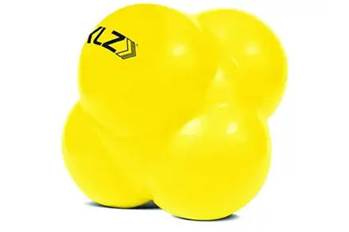
Reaction balls will bounce in every which direction, which forces the players to focus, and even then, they might have to take two or three stabs at it. You’ll find that, for the most part, the better players will be able to carry on as usual, and the best part about these little things is that they throw and catch just like a regular lacrosse ball, so you can do combination GB-pass-pass drills as well.
You can play musical chairs with ground balls, too. Have three guys chase down two balls. The player who doesn’t come back with a ball gets back in the front of the line… or does five pushups. Have some fun with it – try sending five players after four balls. No teams; everyone for himself.
I grew up doing a lot of 2v1 ground balls. Two lines against one (and when I was in elementary school, I somehow always seemed to get stuck in that middle line). These days, I use this procedure: if (when!) the two guys get possession, they have to complete a pass before making a second pass to me. If the single player somehow gets the ball, his outlet is me. Defenders cannot shut off; they have to play the guy with the ball. Encourage the ball carrier to step directly towards the defender – draw him – and then pass as soon as possible.
All well and good, but over the course of a season, you can get pretty beat up, so last year, we backed off a bit. In a kinder, gentler version, I still have three lines – 2v1 still – but the only contact permitted is boxing out. There’s no body-checking, and no stick-checking. Instead, the emphasis is on talk, body position, and quick execution. The middle man’s job is to make the other two communicate and execute.
Another “soft” ground ball drill is what I’m calling our “escape drill.” Three vs. three (different colors helps!)… coach throws a ball into the crowd... goal of the drill is to get the GB and escape the crowd ASAP. No stick-checking; nobody gets hurt. Someone has to put their head down, scoop up that ball, and get out of town. No real resistance. Let each group of six do three reps or so (watch that the players don’t start saying who’s got the next one – keep it unscripted).
For other stick drills, I call my favorite the “box-cutting” drill. Four corners with about 2-4 players in each corner… drill starts with one corner (Point A) rolling out – see above – and passing to an adjacent corner (Point B) cutting (running!) through the middle. He catches the ball and passes it to the line diagonal to him (point C). That player rolls out and passes to another cutter, this one cutting from the fourth corner (Point D). He catches and throws diagonally back to where the drill started (Point A). Players go to the line they threw to. The square (or rectangle) can be as big or small as you want. Teaching points include players moving their feet and throwing in front of the cutters when feeding, cutters sprinting through the middle, and no strict LH/RH rules, though we do encourage the players to use both hands over the course of the drill. I like to add a second ball once they’ve got the hang of the drill, but remind feeders it is their responsibility to watch for potential collisions in the middle – don’t get your teammate hurt!
I first saw what I call the pinwheel drill in Maryland’s pre-game at a Final Four a while back. Players work from the center and pop out to the perimeter in four lines, timing their cuts so as not to arrive too early or too late. On the inside, players work clockwise or counterclockwise, changing lines as they work through the drill. With one ball, you probably need at least 8-12 players, but again, we like to use two or even three balls, so 12-16 works, too... Skills can vary – catch right, throw right (to your left); catch right, roll away and pass left-handed; catch right, throw behind-the-back RH to your left; etc. This drill also requires some communication but most importantly emphasizes timing.
Back when we practiced in Laker Hall’s three-court gym, I used to try to simulate clearing by taking a hockey concept and turning it into a lacrosse drill. I’d have maybe five lines of defensemen (and goalies if available) and throw the ball into the far corner of the gym. All five players – playing on the same team – had to run down past a specified point as one would pick up the ball. Then all five had to handle the ball as they ran back to me. Besides stick skills, they also had to communicate. Once they got confident with this “dump-in” drill, I’d have one, two or maybe even three riders follow the clearing group and give them varying degrees of pressure – if outside, they could go hard; if inside, it was just a token stick wave.
A stick drill I’m still trying to perfect is what I call the “four-man chaos” drill. Four players, one ball. Player 1 throws ball at Player 2, who does not catch it (maybe it hits his hand, or stick, or head, etc.) and it hits the ground. Player 3 immediately swoops in and picks up GB and passes to Player 4, who then starts the drill over by throwing ball at Player 1. Now Player 2 gets the GB, and so on. Spacing, timing, and memory of the sequence seem to be challenges, but I’ve had players tell me they like the drill because they have to talk their way through it.
So, those are the stick skill drills I’ve tweaked or experimented with.
Now let’s talk about running, games, and disguised conditioning.
First, I love paired or small-group sprints. I think players run harder. After two or three reps, I encourage them to change partners and challenge one another. Distances are usually about 40 yards or so, but I’ve never measured them.
And sometimes I have them do every different start I can think of – lying on their stomachs, head in front. Lying on stomachs, feet out front. Same, only starting on their backs. Or maybe 90-degree starts, getting up to their right one time and then getting up to their left the next. Backwards running. Forwards-backwards-and-then-forwards again. “Keep ‘em guessing” is what I like to say!
I’ve also picked up some kids’ variations of tag that work fine with college student-athletes. These might be hard to describe, so feel free to check in with your local elementary school PE teacher if you have any questions (they’ll probably send you home with 20 more ideas)…
Linear Tag. Set four cones in a line – Cone 1 at one end, and Cone 2 about three yards from there. Cone 3 is about 15 yards away, and Cone 4 is on the far end about three yards from 3. Player 1 starts at Cone 1 and Player 2 starts at Cone 2. On the whistle, Player 1 chases Player 2, trying to tag him. Player 1 stops at Cone 3 and reverses direction, while Player 2 stops and turns at Cone 4. The chaser becomes the “chasee.” Players continue to sprint and turn until a tag is made. This could happen quickly, or it could go for quite a few reps.
Half-Circle Tag. Same concept as above, except the course is a half-circle (think the “soccer circle” at the center of most turf fields). Now they’re turning as they sprint.
Figure 8 Tag. Similar chase game, except now runners are following cones creating a Figure 8, and one player is the chaser the entire time (no change of roles). The challenge is to be fast enough to make a tag – or to not get tagged!
Dodging through the gates. Start with a straight line of maybe 15 cones, about 15 yards long. Use two different colored cones at each end to create two “gates.” Two players start at the middle, facing one another, one on each side of the line. One is the designated dodger; the other is the chaser. On the whistle, the dodger can run right or left, dodge back and forth, fake-right-go-left and vice versa, as he tries to get enough steps on his chaser to allow him to run through either gate without getting tagged. The chaser has to stay on his side of the cones.
Four-Corner Steal the Bacon. Got this from a soccer coach. Great for quickness and reaction, and players will be exhausted after a few reps. Set up cones in squares of about 20-25 feet. Place seven (not six, not eight) pinnies, balls, gloves, or other items in the center (if at lacrosse practice, I recommend gloves, but soccer used balls). Four players start from their “home corners.” On the whistle, they try to collect three gloves at their corner, but they can only carry one at a time. They can take gloves from the center, or they can steal gloves from the three other corners. First player to have three gloves in his corner wins. Wearing helmets is not a bad idea.
And yes, we’ve been known to break out a few rounds of “sharks and minnows” from time to time, too. And not one word of protest – ever.
In the past I’ve shared favorite indoor drills, but today’s suggestions are all pretty good for small indoor places and out on the practice or game field. Like I said, my goal is to find different drills to work on the same skills.
And the toolbox has plenty of room for more.
It better; I’m hoping to get to at least one D-I practice this week to look for more.
Thanks for reading. Please consider subscribing at roadtripdad.com to receive weekly RTD newsletters via email. It’s free – really! No fine print; no catches.
In the meantime, please drive carefully, everyone. Put down those cell phones. Volunteer. Donate blood. Get your shots. Love your neighbor. Help someone in need and always take care of your crew!
But most importantly, stay safe, stay smart, and stay kind.
- Dan Witmer
Dan is currently the author of four books. The Best of Road Trip Dad – The Laker Lacrosse Collection is an accumulation of 45 articles written for www.JustLacrosseUpstate between the years 2012 and 2018, about the history and traditions, the people, and the stories of the Oswego State men’s lacrosse program. … and piles to go before I sleep – The Book of Wit is his memoir describing his 33-year career teaching HS English and coaching at Hannibal Central School. His third book, The Best of RTD – A Lacrosse Coach’s Handbook contains more than 55 weekly Road Trip Dad blogs spanning 2012-2020, featuring Xs and Os, highs and lows, and even some Dos and Don’ts, and plenty of advice for coaches of all levels. His latest book, The Best of Road Trip Dad – On the Shoulders of Giants: Upstate’s Lacrosse Founders and Legends, profiles more than 50 icons who helped grow the game in Upstate NY. All four books are available at www.amazon.com.
Dan grew up in Lynbrook, NY before coming to Oswego State to earn his teaching and coaching certifications. He then taught English at Hannibal High School for 33 years before retiring in 2015.
In addition to coaching the Oswego State Laker men’s lacrosse team part-time from 1982-2010, Dan also coached JV and varsity girls’ soccer at Hannibal for 16 years, girls’ ice hockey at Oswego HS for 8 years, and boys’ JV and varsity lacrosse at Oswego HS for 12 years.
Dan is now in his 18th year assisting Summit Lacrosse Ventures (now the PLL) with their various tournaments, especially the annual Lake Placid Summit Classic, and he worked for 3d Lacrosse for three years as well. He has served on the staffs of the 2014 FIL World Games in Denver, the 2015 FIL Indoor Championships in Syracuse, the 2018 FIL World Games in Netanya, Israel, the 2022 U21 World Championship in Limerick, Ireland, and the World Lacrosse Championships in San Diego in 2023. He was the game ops staff director for the World Lacrosse Men’s and Women’s Box Championships in Utica in September of 2024, and he just served as the field manager at the World Lacrosse Men’s U20 championships in Jeju, South Korea. In 2023, he created Witmer Solutions LLC, a lacrosse event staffing and internship offering service that he hopes will get his foot – and others’ – in the door at lacrosse events worldwide.
Dan served as the Community Service Coordinator for the Oswego State athletic department from 2010-2023 and has been a certified lacrosse referee for the past seven years. He has also been the Volunteer Event Organizer for the annual St. Baldrick’s fundraiser in Oswego from 2007-2024, raising more than one million dollars for childhood cancer research.
In the fall of 2022, he returned to the Oswego State coaching staff as an assistant coach, where he currently serves as defensive coordinator and alumni liaison.
Dan and Sue Witmer live in Oswego, while their older son Brian lives in Prague with his wife Jane and son Benji, and younger son Eric lives in Denver, CO. Both earned degrees at SUNY Brockport and played four years of lacrosse for the Golden Eagles.
The hope is for many more road trips to come.